The idea of this blog is to provide students with extra information about history and literature in order to work at home for the English class. It can also be used as a means of communication between us. Important information as regards tests, homework and marks may be added here.
Things to remember about the use of the blog:
· Read the blog from bottom to top. · Try to become a member. If you have a google or gmail account it is very simple! Just follow instructions or press on "Followers - Join this site" · If you post a comment, but are not a member, press anonymous but sign your name. Unsigned comments will not be posted. · Homework will be posted weekly. No excuses are accepted. DON'T EVEN TRY.
Although the name has since taken on connotations of repressive
morality, the first Puritans were reformers and dissenters against the
established Church. The following areas were important issues for most
Puritans:
separation from the Roman Catholic Church and its traditions
simplified forms of worship; a dislike of church ritual, robes,
music, idolatry &c
an emphasis on personal interpretation of the Bible
attendance of public sermons by gifted lay preachers rather than
state-regulated services in local parish churches
strict observance of the Sabbath and a disregard of festivals and
Saints' days
The term came into general use in England during the reign of the
Catholic Queen Mary I (1553-8), usually as a term of derision. Its use as a
label to identify a particular viewpoint within the Church of England dates
from the early reign of Elizabeth I. The first Puritans wanted to purge or
"purify" the Anglican Church of any traces of Catholic influence that
remained after the Elizabethan Church settlement. During the reign of King James I, many Puritans were driven abroad, some
to Holland and Germany, some to America, notably the Pilgrim Fathers in 1620.
Puritans suspected King Chales I of having Catholic sympathies from the beginning of his reign. His
marriage to the Catholic princess Henrietta Maria and his support for attempts impose strict doctrines upon the
Anglican church were regarded with deep mistrust. Most of the members of the Long Parliament who remained at Westminster after the outbreak of civil
war in 1642 were Puritan in outlook. After the defeat of the Royalists in the
First Civil War, the settlement of religion began to dominate proceedings in
Parliament.
The Puritan ideal of a commonwealth ruled by a godly government of
"Saints" reached its peak with the short-lived Nominated Assembly of 1653. The Assembly was replaced by the Protectorate
of Oliver Cromwell, who tried to establish a broadly-based national Church with
toleration of law-abiding Protestant sects. Cromwell's attempt to reform the
morals of the nation under the Rule of Major-generals (1655-7) proved deeply unpopular. The Restoration of the Monarchy in 1660 also restored Anglicanism and
the rule of the bishops. Puritan clergy were expelled from the Church of
England under the terms of the Act of Uniformity of 1662. Thereafter, English
Puritans were classified as Nonconformists
After you read, answer!
Why were they called puritans?
When did this happen?
When did it change?
Did they leave England? When? Why? Where to?
What did they prohibit during the commonwealth rule?
what are they called now?
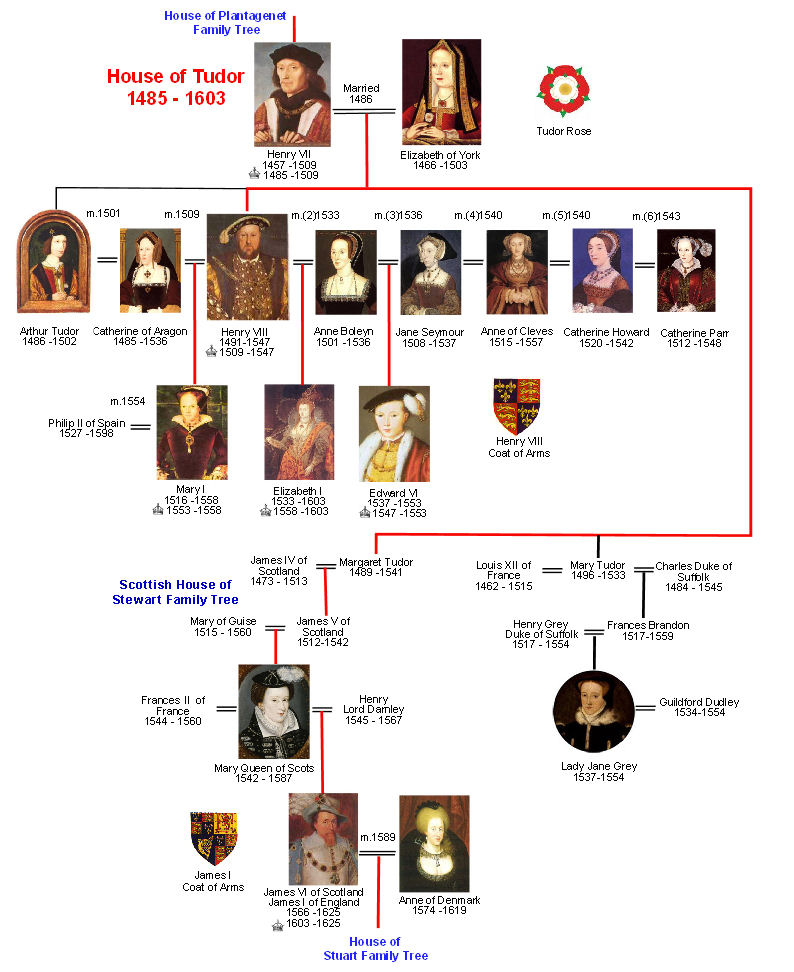
1. How many children did Henry VII and Elizabeth of York have?
2. What is the relationship between Henry VIII and James V of Scotland?
3. How many times did Mary Queen of Scots marry? How many children did she have?
4. What is the relationship beween Mary Queen of Scots and Lady Jane Grey?
5. What is the relationship beween Mary Queen of Scots and Queen Elizabeth I?